Fashion and Personality – How Style Shapes Identity
Standing in front of your closet, it’s clear every outfit choice says something real about who you are. For young adults immersed in streetwear, style goes way beyond following trends—it connects your inner world with your outward image. Research from Massachusetts General Hospital and London College of Fashion shows distinct clothing styles reflect personality traits, confirming your wardrobe is a tool for bold self-expression and identity construction. This article breaks down how fashion and personality shape your unique streetwear vibe.
Table of Contents
- Fashion And Personality Defined Clearly
- Streetwear Styles And Personality Types
- How Clothing Choices Reflect Inner Self
- Cultural And Social Influences On Style
- Risks Of Stereotyping And Misjudgment
Key Takeaways
| Point | Details |
|---|---|
| Fashion Reflects Identity | Your wardrobe choices express who you are, indicating personality traits and values. |
| Understanding Your Style | Identify your personal style by recognizing patterns in your preferences and the emotions your clothing evokes. |
| Cultural Influence Matters | Fashion is shaped by cultural backgrounds, social contexts, and community influences; understanding this enhances personal expression. |
| Challenge Stereotypes | Wear what genuinely expresses you to counteract societal stereotypes and expand acceptance in fashion. |
Fashion and Personality Defined Clearly
Fashion and personality are deeply intertwined. Your wardrobe isn’t random—it reflects who you are, how you think, and what matters to you. Understanding this connection transforms how you approach getting dressed.
Fashion refers to the choices you make about clothing, colors, and style. It’s the tangible expression through garments, accessories, and how you put them together.
Personality encompasses your core traits, values, and the way you naturally interact with the world. It’s your inner character made visible.
When these two intersect, something powerful happens: your clothing becomes a tool for self-actualization.
The Science Behind Style and Self
Research confirms what you probably already sense. Clothing style associations with personality traits reveal measurable patterns. Studies identified four distinct clothing style categories—essential, comfortable, feminine, and trendy—each linked to specific personality characteristics.
Here’s what the research shows:
- Essential clothing wearers display sociability and emotional stability
- Feminine style preferences correlate with compassion and fashion leadership
- Color choices reflect deeper personality dimensions
- Fashion preferences stem from self-knowledge and consistency
Your clothing isn’t superficial. It’s a direct line to your identity.
How Style Becomes Your Identity
Fashion operates on three levels within identity construction. First, it expresses your true self—who you genuinely are right now. Second, it represents your ideal self—who you aspire to become. Third, it channels your creative self—your artistic vision and individual expression.
When you choose an outfit, you’re unconsciously answering questions: “Who am I today? Who do I want to be? How do I want to be perceived?”
Your answers shape every piece you select.
Style acts as a vehicle for actualizing desired self-conceptions and channeling creative potential.
This explains why you feel confident in certain outfits and uncomfortable in others. Alignment between your clothing and your identity creates authenticity. Misalignment creates friction.
What Makes Your Style Personal
Your fashion choices rest on three foundations:
- Self-knowledge – Understanding your preferences, body, and values
- Consistency – Making choices that align with your authentic self
- Comfort – Selecting pieces that allow you to move, think, and feel like yourself
Young adults in streetwear culture understand this instinctively. You’re not following trends blindly—you’re curating a visual language that communicates your artistic mindset and individuality.
Bold apparel that merges art and symbolism becomes your statement. Each piece signals something about how you see yourself and the world.
The Connection You Already Know
You’ve experienced it. Someone walks into a room wearing clothing that aligns with who they are, and you notice immediately. There’s an energy, a coherence, a sense of presence. That’s what happens when fashion and personality align.

Conversely, when someone wears something that doesn’t match their vibe, you sense the disconnect.
This isn’t magic. It’s the visible manifestation of internal consistency.
Pro tip: Start noticing which pieces make you feel most like yourself—not what photographs well or what others praise. Those items are your authenticity anchors. Build your personal style around them.
Streetwear Styles and Personality Types
Streetwear isn’t one look. It’s a spectrum of styles, each reflecting different personality traits and values. Your streetwear choices communicate something specific about who you are.
The connection runs deep. Streetwear consumers’ brand preferences and identity constructs reveal that self-identity, confidence, and social circles shape every decision. You’re not just buying clothes—you’re signaling your place in a community.
Your personality type determines which streetwear direction calls to you.
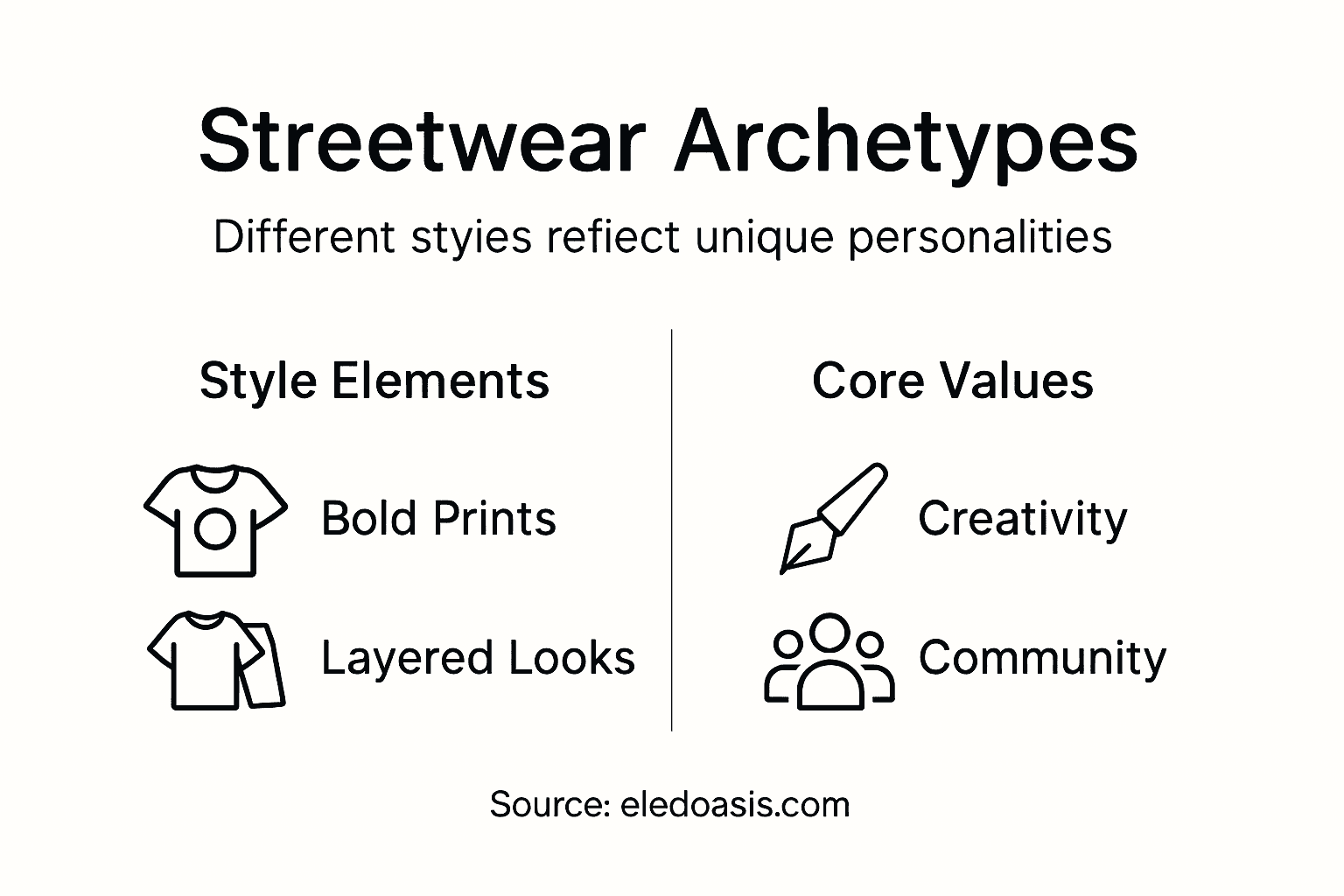
The Main Streetwear Personality Archetypes
Different streetwear styles align with distinct personality profiles. Understanding which resonates with you helps you shop intentionally and build a cohesive personal brand.
Here are the core archetypes:
- The Creative Visionary – Experimental, artistic, drawn to bold colors and symbolic pieces
- The Minimalist – Values simplicity, clean lines, neutral palettes, and timeless quality
- The Cultural Connector – Celebrates hip-hop, skateboarding roots; embraces heritage and subculture codes
- The Trendsetter – Confident, forward-thinking, blends styles before they hit mainstream
- The Comfort-First Creator – Prioritizes function and ease; pieces work for creative flow
- The Statement Maker – Uses apparel as activism; every choice carries meaning and message
You might identify with one or blend several. That blending is your authentic style.
To better understand the major streetwear personality archetypes and their preferred style, here is a concise comparison:
| Archetype | Signature Style Elements | Core Values |
|---|---|---|
| Creative Visionary | Bold colors, symbolic items | Artistic expression |
| Minimalist | Neutral tones, clean lines | Simplicity, timelessness |
| Cultural Connector | Heritage motifs, brand logos | Community, authenticity |
| Trendsetter | Emerging designs, unique cuts | Innovation, leadership |
| Comfort-First Creator | Functional, breathable fits | Ease, practicality |
| Statement Maker | Activist graphics, eco brands | Advocacy, purpose |
What Each Type Actually Values
Creative Visionaries seek pieces that merge art and symbolism. Bold hues, unexpected textures, and conceptual designs energize them. They see clothing as canvas.
Minimalists want quality over quantity. Every piece must earn its place. Neutral tones, clean construction, and timeless silhouettes matter more than trends.
Cultural Connectors understand streetwear’s roots in skateboarding and hip-hop. They respect brand narratives and community history. Authenticity and cultural knowledge drive their choices.
Trendsetters move ahead of the curve. They research emerging designers and emerging aesthetics. Risk-taking excites them more than playing it safe.
Comfort-First Creators need clothing that supports their lifestyle. Functionality, breathability, and movement freedom come first. Style follows utility.
Statement Makers want pieces with purpose. They choose brands and designs aligned with their values—sustainability, social consciousness, rebellion against norms.
Your streetwear personality type determines not just what you buy, but why you buy it.
How Personality Shapes Your Choices
Research on Generation Z streetwear users reveals that streetwear represents creativity, confidence, and community values. Young enthusiasts don’t view streetwear as mere clothing—it’s a lifestyle and identity statement.
Your personality drives:
- Brand loyalty and narrative preference
- Color and aesthetic selections
- Quality standards and investment level
- Social circle alignment
- How you mix and match pieces
Introverts might prefer understated pieces that command presence through cut and quality. Extroverts gravitate toward louder colors and logo-forward designs. Analytical minds seek functional details. Emotional personalities chase feeling and vibe.
None of these is better. They’re different expressions of self.
Finding Your Streetwear Personality
You likely already know which category fits. But test it: look at your current closet. What colors dominate? What brands do you return to? Which pieces make you feel most yourself?
Those patterns reveal your true streetwear personality—not what you think you should like, but what actually resonates.
Pro tip: Before buying new pieces, identify your personality archetype and check if new items align with it. This prevents closet clutter and ensures every purchase strengthens your authentic style rather than diluting it.
How Clothing Choices Reflect Inner Self
Your closet tells your story. Every piece you own, every color you reach for, every style you embrace—these are signals from your inner self seeking expression. What you wear is rarely accidental.
Clothing functions as a mirror. Psychological factors including personality and cultural beliefs shape what you choose to put on your body. Your outfit communicates who you are before you speak a single word.
Understanding this connection helps you dress more authentically.
The Three Selves Your Clothing Expresses
Your wardrobe doesn’t just reflect one version of you. It expresses three distinct aspects of your identity simultaneously.
Your True Self is who you actually are right now. It’s your current personality, values, and comfort level. Clothes aligned with your true self feel natural and require no mental adjustment.
Your Ideal Self is who you aspire to become. These pieces inspire and motivate you. Wearing them signals intention and pushes you toward growth.
Your Creative Self is your artistic expression. This is where bold apparel and symbolic pieces live. Your creativity demands outlets, and fashion provides one.
Your clothing is an ongoing conversation between who you are, who you’re becoming, and who you dream of being.
How Inner Traits Shape Outfit Choices
Your personality doesn’t just influence fashion preferences—it dictates them. Clothing styles express true self, ideal self, and creative self through specific mechanisms that operate below conscious awareness.
Here’s how inner traits manifest:
- Confidence levels determine whether you choose bold colors or subtle tones
- Value systems guide brand selection and ethical considerations
- Creative drive pushes you toward experimental or conventional styles
- Social orientation influences whether pieces signal belonging or distinction
- Comfort needs shape practical features like fit, mobility, and breathability
- Self-knowledge determines how intentional your choices become
Someone driven by authenticity gravitates toward consistent, honest pieces. Someone exploring identity tries multiple styles. Someone confident in themselves stops seeking external validation through clothing.
The Functions Your Clothing Serves
Clothing does six critical jobs beyond keeping you warm. Understanding which functions matter most to you reveals inner priorities.
- Self-Expression – Communicating your personality and values
- Individuality – Standing out and asserting uniqueness
- Social Signaling – Indicating belonging to specific groups or communities
- Attraction – Presenting yourself as capable or appealing
- Protection – Creating psychological or physical safety
- Political Expression – Making statements about beliefs and affiliations
You weight these differently. An artist might prioritize self-expression and individuality. A corporate professional might lean on social signaling and attraction. A streetwear enthusiast blends all six simultaneously.
Here’s a quick summary of how clothing functions as more than just something to wear—each serves distinct psychological purposes:
| Function | Impact on Identity |
|---|---|
| Self-Expression | Reveals personality traits |
| Individuality | Highlights uniqueness |
| Social Signaling | Indicates group membership |
| Attraction | Boosts confidence |
| Protection | Provides safety and comfort |
| Political Expression | Affirms beliefs and values |
Reading What Your Closet Reveals
Your actual clothing choices—not your aspirations—show your true inner self. Look at what you actually wear versus what hangs unworn.
Do you reach for comfort? You value ease and functionality. Do you grab statement pieces? You’re expressing creativity or seeking to be seen. Do you wear coordinated outfits? You’re organized and intentional. Do you mix wildly? You’re experimental and comfortable with risk.
Your color choices reveal emotional states. Your fit preferences show confidence levels. Your brand loyalty indicates values alignment. Your willingness to spend signals what you truly prioritize.
These patterns never lie.
Pro tip: Keep a style journal for one week—photograph what you wear daily and note how you felt in each outfit. Patterns emerge fast, revealing your authentic preferences versus what you think you should like.
Cultural and Social Influences on Style
Your fashion choices aren’t purely personal. Culture, community, geography, and history shape what you reach for every single day. Understanding these forces helps you build a style that’s both authentically yours and connected to something larger.
Fashion operates on two levels simultaneously. It’s a tool for individual self-expression and a deeply social phenomenon reflecting cultural values. You’re constantly negotiating between these two forces.
This tension is where your real style emerges.
How Culture Shapes Your Wardrobe
Fashion shapes identity while reinforcing group affiliations and social norms. Your cultural background—whether it’s explicit or invisible to you—influences color preferences, fit comfort, coverage expectations, and what feels appropriate.
Culture operates through multiple channels:
- Family traditions – What you watched your parents wear matters
- Geographic location – Climate, local style tribes, and regional aesthetics shape options
- Religious or spiritual beliefs – Modesty standards, color symbolism, and dress codes
- Generational trends – What felt normal for your parents feels dated or forward to you
- Socioeconomic context – Access, brand availability, and what signals status
- Media representation – Who you see wearing what normalizes certain choices
You absorb these influences without conscious awareness. Then you remix them with your personality.
The Power of Cultural Hybridity
Modern streetwear culture thrives on blending. You might wear traditional garments with contemporary designs. You mix high-fashion with thrifted pieces. You blend your heritage with global trends.
This isn’t cultural confusion—it’s cultural intelligence. Clothing choices express cultural affiliation and individual identity through hybridity, combining tradition with contemporary expression.
Young adults navigate multiple cultures simultaneously. You honor where you come from while creating something entirely new. Your style becomes a bridge.
Your fashion choices mediate between your roots and your future.
Social Circles Shape Your Aesthetic
Your crew influences what you wear. Not through pressure necessarily, but through exposure and shared language. Inside your community, certain pieces signal belonging.
Subcultures within streetwear operate this way. Skate culture has its codes. Hip-hop influenced fashion has its signals. Art-focused communities have aesthetic markers. You recognize members instantly.
This isn’t conformity. It’s communication. Wearing pieces that align with your community’s values signals values alignment. It says “I’m part of this.”
But here’s the thing: you can belong while remaining distinct. The strongest personal styles respect community language while adding individual voice.
Economic and Social Context
Access shapes options. Where you live, what you can afford, what retailers stock—these create boundaries. Within those boundaries, you make choices.
Sustainable consumption matters here. Conscious choices about quality, longevity, and ethical production reflect both personal values and cultural shifts. Your generation cares about this differently than previous ones.
Brand loyalty often reflects cultural values too. You might choose independent brands over corporations. You might support Black-owned or minority-owned labels. Your dollars align with your beliefs.
Finding Your Cultural Voice
You don’t need to choose between cultural heritage and personal expression. The goal is integration. Honor where you come from while building something authentically yours.
Ask yourself: Which cultural influences energize me? Which feel authentic versus obligatory? Where can I blend tradition with innovation?
Your best style answers these questions.
Pro tip: Research the cultural origins of styles you love—from streetwear subcultures to fabric traditions. Understanding the “why” behind pieces deepens your style choices and builds respect for the communities that shaped them.
Risks of Stereotyping and Misjudgment
Your outfit tells a story. But people often read it wrong. They make instant judgments based on incomplete information, cultural biases, and harmful stereotypes. Understanding these risks protects both your self-expression and your judgment of others.
Stereotyping in fashion runs deep. Fashion industry stereotypes perpetuate harmful limiting beliefs about body image, race, gender, age, and beauty. These biases shape how people perceive you before you speak.
But here’s what matters: your style doesn’t need to fit anyone’s expectations.
How Stereotyping Actually Works
Stereotypes operate through visual shorthand. Your brain processes clothing instantly and assigns meaning. A hoodie might signal something different depending on the wearer’s race. Baggy clothes might mean different things on different bodies. Feminine pieces carry assumptions about gender identity.
Color, materials, and visual motifs perpetuate stereotypes throughout design and fashion. Pink signals femininity. Black signals toughness or rebellion. These associations feel natural but they’re constructed.
The fashion industry reinforced these patterns for decades. Only recently has that started shifting.
The Stereotypes You’ll Encounter
You might face judgment based on:
- Body shape – Assumptions about health, capability, or attractiveness
- Race and ethnicity – Stereotypes about cultural appropriation or belonging
- Gender expression – Assumptions about sexuality or identity based on clothing choices
- Age – Judgment about what you should or shouldn’t wear
- Subculture affiliation – Assumptions about your values or behavior based on streetwear codes
- Socioeconomic status – Judgments about wealth, taste, or intelligence
None of these judgments are accurate. They’re shortcuts your brain takes when it lacks real information.
Your clothing choices don’t determine your worth, intelligence, morality, or future.
The Real Danger: Self-Limiting Beliefs
The bigger risk isn’t what others think. It’s internalizing their stereotypes and limiting yourself. You might avoid wearing something you love because you fear judgment. You might dress in ways that feel inauthentic to fit narrow expectations.
This shrinks your identity rather than expanding it. Your personal style suffers. Your confidence erodes.
Young adults in streetwear culture understand this instinctively. You’re actively rejecting limiting stereotypes by wearing bold apparel that claims space. You’re saying: “I don’t fit your categories. Accept it.”
That takes courage.
Breaking Stereotypes Through Style
The strongest response to stereotyping is authenticity. Wear what genuinely expresses you. Let your choices challenge expectations.
You can:
- Blend categories – Mix feminine and masculine pieces, traditional and contemporary, high and low fashion
- Reclaim coded pieces – Wear what you want regardless of historical stereotypes attached
- Lead with confidence – Uncertainty invites judgment; certainty shuts it down
- Support inclusive brands – Choose designers actively working against stereotypes
- Educate through visibility – Your authenticity teaches others what’s possible
When you dress authentically, you expand what’s acceptable for everyone.
Avoiding Your Own Stereotyping
Remember: you also make instant judgments. Someone’s streetwear choices don’t reveal their values, intelligence, or character. A person’s style doesn’t justify assumptions about their background or identity.
Practice seeing beyond the surface. Ask questions before concluding. Stay curious instead of categorical.
This matters for building genuine community and for being the kind of person who sees others clearly.
Pro tip: Wear one piece each week that directly challenges a stereotype you’ve internalized—whether that’s about your body, gender expression, or subcultural identity. Notice how wearing it shifts your confidence and the actual reactions you receive.
Discover Your Authentic Style With Bold Streetwear That Speaks You
Understanding how fashion connects deeply to your personality unlocks the power of true self-expression. The challenge many face is finding clothing that not only reflects their inner creativity and individuality but also aligns perfectly with their identity — without compromising comfort or authenticity. If you are looking to build a personal style that communicates your unique story through art, symbolism, and confidence, embracing visionary streetwear is the key.
Eledoasis.com offers a curated collection designed to help you bridge the gap between your true self, ideal self, and creative self. Our hoodies, tees, hats, and accessories are crafted for those who dare to be different and want every piece to speak volumes about who they are. Start defining your style on your own terms and reject stereotypes by expressing your real identity through bold apparel that fits your lifestyle.
Shop visionary streetwear now at Eledoasis and transform your wardrobe into a living canvas that reflects your personality and awakens your style consciousness.
Frequently Asked Questions
How does fashion reflect personality?
Fashion serves as a tangible expression of your personality, preferences, and values. The clothing you choose can signal who you are, how you think, and what you prioritize in life.
What are the main streetwear personality archetypes?
The main streetwear personality archetypes include the Creative Visionary, Minimalist, Cultural Connector, Trendsetter, Comfort-First Creator, and Statement Maker. Each archetype reflects different values and stylistic choices.
How can I find my personal style?
To find your personal style, assess your wardrobe and identify which pieces you feel most like yourself in. Consider your preferences, comfort levels, and how your clothing choices align with your personality and values.
What role do cultural influences play in my fashion choices?
Cultural influences shape your fashion choices through family traditions, geographic factors, societal norms, and media representation. These elements impact color preferences, fit, and the styles you gravitate toward.